The Soviet Union, officially the Union of Soviet Socialist Republics (USSR), was a federal socialist state in Northern Eurasia that existed from 1922 to 1991. It was a union of several Soviet Republics under the leadership of its Communist Party. The republics acted in a similar way to the constituent countries of the United Kingdom or the States of the United States. It bordered 16 other countries, Norway, Finland, Poland, Czechoslovakia, Hungary, Romania, Turkey, Iran, Afghanistan, China and North Korea. It also had close maritime boundaries with Japan and the United States.
History
The Soviet Union was created on December 30, 1922, after Vladimir Lenin and the Bolsheviks overthrow the Russian Provisional Government and won the Russian Civil War. Lenin died and was replaced by Joseph Stalin. In August 1939, the Soviet Union signed a non-aggression pact with Nazi Germany; they agreed to divide up Eastern Europe and trade with each other. In late 1939, the Soviets invaded Finland and fought a war for several months, ending up annexing parts of Finland. The Soviet Union invaded and annexed several other countries in the summer of 1940. On June 22, 1941, Nazi Germany invaded the Soviet Union, but the Soviets defeated the Nazis in 1945. Then, the Soviet Union and the United States developed a rivalry, which eventually lead to a Cold War. The Soviets tested their first nuclear bomb, called RDS-1, on Semipalatinsk, Kazakh SSR (now Kazakhstan). The USSR supported communists around the war in several proxy wars to counter capitalist countries. It also created the Warsaw Pact in 1955, which consisted of itself, Poland, Czechoslovakia, Hungary, Romania, Bulgaria, and East Germany. Later, the USSR and America strengthened their relationship with each other, known as Détente. However, tensions rose during the Euromissile Crisis between 1977 and 1982. The Soviets invaded Afghanistan in 1979 but lost in 1989. Mikhail Gorbachev, the new leader, implemented two major policies in the Soviet Union: Glasnost and Perestroika. He also improved relations with the US. From March 1990 to December 26, 1991, the fifteen Soviet republics declared themselves independent, and the Soviet Union collapsed.
Republics
- Armenian Soviet Socialist Republic (1936-1991; now the independent Republic of Armenia)
- Azerbaijan Soviet Socialist Republic (1936-1991; now the independent Republic of Azerbaijan)
- Byelorussian Soviet Socialist Republic (1922-1991; now the independent Republic of Belarus)
- Estonian Soviet Socialist Republic (1940-1991; now the independent Republic of Estonia)
- Georgian Soviet Socialist Republic (1936-1991; now the independent country of Georgia)
- Kazakh Soviet Socialist Republic (1936-1991; now the independent Republic of Kazakhstan)
- Kirghiz Soviet Socialist Republic (1936-1991; now the independent Kyrgyz Republic, more commonly known as Kyrgyzstan)
- Latvian Soviet Socialist Republic (1940-1991; now the independent Republic of Latvia)
- Lithuanian Soviet Socialist Republic (1940-1991; now the independent Republic of Lithuania)
- Moldavian Soviet Socialist Republic (1940-1991; now the independent Republic of Moldova)
- Russian Soviet Federative Socialist Republic (1922-1991; now the Russian Federation)
- Tajik Soviet Socialist Republic (1929-1991; now the independent Republic of Tajikistan)
- Turkmen Soviet Socialist Republic (1925-1991; now the independent country of Turkmenistan)
- Ukrainian Soviet Socialist Republic (1922-1991; now the independent country of Ukraine)
- Uzbek Soviet Socialist Republic (1924-1991; now the independent Republic of Uzbekistan)
Former Republics
- Bukharan People's Soviet Republic (1922-1924; partitioned between the Uzbek, Tajik and Turkmen SSRs)
- Karelo-Finnish Soviet Socialist Republic (1940-1956; re-annexed by the Russian SFSR as an ASSR)
- Khorezm People's Soviet Republic (1922-1924; partitioned between the Turkmen and Uzbek SSRs)
- Transcaucasian Socialist Federative Soviet Republic (1922-1936; divided into the Georgian, Armenian and Azerbaijan SSRs)
Trivia
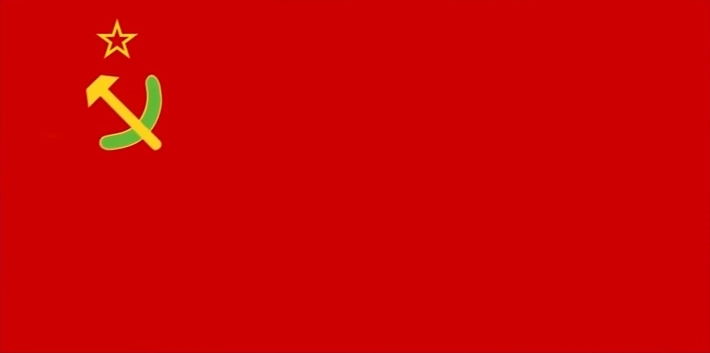
- In the OverSimplified channel, the sickle in the Soviet flag is replaced with a pickle.[1] He most likely did this to avoid using offensive symbols.
- The beginning of "The Cold War" (Part 1) features the Soviet anthem and a Cyrillic-themed script.
- The Soviet Union had 16 official languages, the most of any country featured on this wiki. While the Russian Soviet Federative Socialist Republic had Russian as its primary official language, the two official languages in each of the other 14 republics was their own language along with Russian, but the official languages of the Moldavian SSR were Russian and Moldovan, the latter was actually a dialect of the Romanian language spoken in nearby Romania, and the Tajik SSR was the only SSR that had three official languages, Russian, Tajik and Tajik Persian, the latter, Tajik Persian, is written in the Perso-Arabic script rather than the Cyrillic script like Russian and Tajik, and while Tajik is considered its own language within the Indo-Iranian languages, Tajik Persian, as the name suggests is actually a dialect of the Persian language also spoken in nearby Iran and Afghanistan.
- The Soviet Union had six founding republics, Russia, Ukraine, Byelorussia (now known as Belarus), Bukhara, Khorezm and Transcaucasia, of which the latter half were broken apart or partitioned between other republics.
Appearances
- WW2 (both parts)
- The Cold War (both parts)
- The Russian Revolution (Part 2) [mentioned]
References
- ↑ In many scenes where the Soviet Union is shown, such as its flag, the hammer and pickle are seen.
| Countries in WW2 (template) |
|---|
Australia •
|


| Countries in the Cold War (template) |
|---|
United States • United Kingdom • France • Norway • Denmark • West Germany • The Netherlands • Belgium • Luxembourg • Spain • Portugal • Iceland • Greece • Turkey • Italy Soviet Union • Polish People's Republic • Czechoslovak Socialist Republic • Hungarian People's Republic • Socialist Republic of Romania • People's Republic of Bulgaria • East Germany |